

Establishing total SAS Viya open-source security requires a dual-layered strategy that governs both runtime code execution and incoming package software supply chains. The integration of Python and R into the SAS Viya platform represents a major step forward for enterprise analytics. By allowing data science teams to blend the distributed, in-memory power of Cloud Analytic Services (CAS) with open-source libraries across both batch and interactive SAS Compute Server sessions, organisations are driving rapid innovation. However, this flexibility demands a dual-layered security strategy. Historically, IT security teams focused on hardening the server environment where code executes. In an operational landscape where open-source packages are updated daily across public registries, securing the execution environment is no longer enough; you must also secure the underlying software supply chain.
The tension between developer agility and enterprise risk control often centres on package access. Data scientists require modern libraries to solve analytical problems, while Chief Information Security Officers must prevent unvetted, malicious code from entering core environments. The reality for executive leadership is clear: if your execution host is hardened but your open-source supply chain remains open to public repositories, your platform remains vulnerable to typosquatting, dependency confusion, and automated injection attacks. This discrepancy creates an enterprise “Governance Gap.” To bridge it, platform architects must distinguish between execution controls, which govern runtime activity, and supply-chain controls, which govern incoming package assets.
A hardened analytics environment requires two distinct domains of governance to operate safely at scale. Treating the act of running code and the act of acquiring code as the same risk vector leads to structural vulnerabilities.
Execution Governance focuses on the runtime environment, ensuring that once an analytical process starts—whether inside an interactive user session, a scheduled batch processing script, or a distributed CAS action—it operates within strictly defined system parameters. Supply-Chain Governance acts as the upstream firewall, controlling exactly which packages, dependencies, and version builds are permitted to enter the corporate environment in the first place.
| Governance Category | Execution Governance | Supply-Chain Governance |
|---|---|---|
| Primary Goal | Control process actions and file access at runtime. | Control code binaries and libraries before entering the environment. |
| Control Mechanism | Declarative policy files (extlang.xml), LOCKDOWN mode, and SAS Watchdog. |
Curated repositories, OSV vulnerability scanning, and license filtering via Posit Package Manager. |
| Target Workloads | SAS Compute Server (batch & interactive) and CAS nodes. | Centralised sas-pyconfig build engine and persistent volume mounts. |
| Threat Vector | Arbitrary code execution, privilege escalation, and unapproved file system reads. | Typosquatting, dependency confusion, malicious code injection, and known vulnerabilities (CVEs). |
While SAS Viya provides thorough execution governance, complete posture protection requires a specialised partner solution like Posit Package Manager (PPM) integrated alongside Selerity’s managed platform hosting to govern the upstream supply chain.
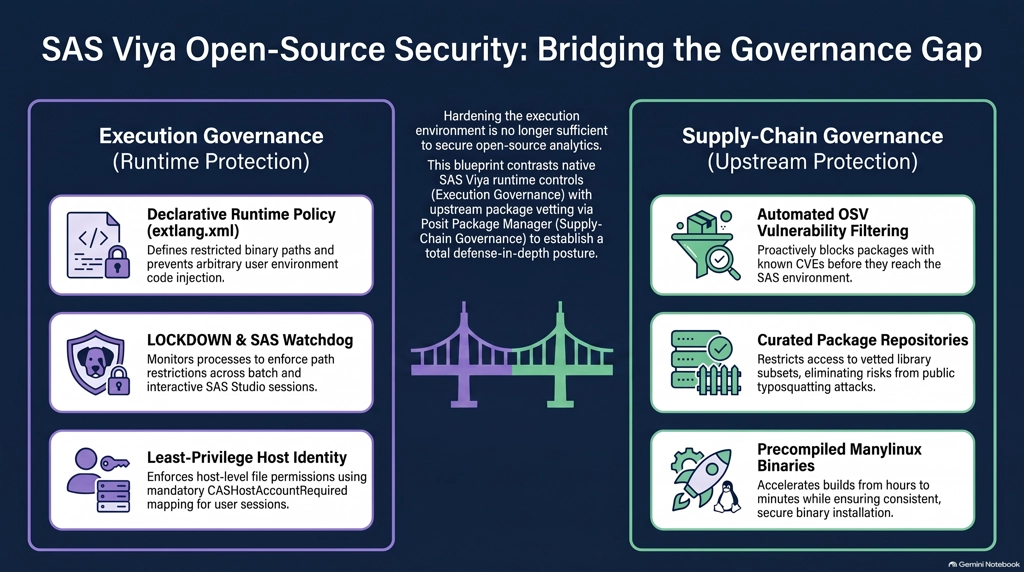
The SAS Viya runtime security model uses Kubernetes-native configurations to establish a least-privilege baseline. This ensures that open-source code execution cannot breach the integrity of the broader platform.
The technical foundation for governing external languages in CAS is the extlang.xml configuration file. This declarative control point allows administrators to define explicit boundaries for Python and R processes. Key parameters include:
/opt/sas/viya/home/sas-pyconfig/) and define isolated scratchDisk locations, preventing external scripts from writing to or reading from sensitive system directories.userSetEnv="BLOCK" and userInlineCode="BLOCK" prevents users from injecting unapproved environment variables or executing ad hoc code strings that bypass corporate auditing.CASHostAccountRequired custom group enforces host-level file permissions. Note: This group ID is strictly case-sensitive; mismatched casing causes immediate authentication failure.To protect SAS Compute Server workloads—covering both background batch processing jobs and interactive SAS Studio user sessions—SAS Viya employs LOCKDOWN mode and the SAS Watchdog process. SAS Watchdog monitors spawned Python and R processes to enforce LOCKDOWN path restrictions, preventing unauthorised file system traversal.
However, system architects must note a key structural boundary: LOCKDOWN mode and SAS Watchdog specifically protect the SAS Compute Server. They do not restrict Python execution within SAS Visual Forecasting (TSMODEL), the SAS Micro Analytic Service (MAS), or raw CAS worker nodes. Security across the entire footprint requires unified upstream controls.
From a DevSecOps operational perspective, the CAS controller mounts the storage volume containing open-source runtimes as read-only. To update extlang.xml or deploy new runtime configurations, an administrator must launch a dedicated utility pod that mounts the sas-pyconfig Persistent Volume Claim (PVC) in read-write mode to apply configuration changes safely.
A significant vulnerability exists when an analytics platform automates open-source runtime builds without an upstream gatekeeper. In SAS Viya, the SAS Configurator for Open Source (sas-pyconfig job) automates the installation of Python and R environments. It uses a change-configuration.yaml manifest and verifies md5sum hashes to ensure build consistency across cluster nodes.
However, build consistency is not the same as software security. The sas-pyconfig job fetches packages directly from public mirrors such as PyPI or CRAN. Without an upstream security filter, an automated sas-pyconfig build job will successfully compile a consistent, functional environment that contains compromised packages introduced through typosquatting or dependency confusion attacks. If a public repository hosts a malicious package version, your automated installation engine becomes the delivery mechanism for that breach across all batch Compute jobs and CAS sessions.
Posit Package Manager acts as a proactive firewall between public package repositories and the SAS Viya environment. It ensures that only vetted, compliant, and scanned packages are made available to the sas-pyconfig build engine.
Because sas-pyconfig installs Python and R packages into a shared, persistent volume (sas-pyconfig PVC) accessed by both SAS Compute Server pods (for batch scripts and interactive sessions) and CAS nodes, placing PPM upstream secures the entire SAS Viya platform.


sas-pyconfig engine.curated-cran and curated-pypi sources, IT teams restrict the environment to an approved subset of vetted libraries. This eliminates the operational exposure of unmonitored public mirrors.sas-pyconfig execution. This transforms build processes that previously took hours into reliable installations completed in minutes, eliminating build failures caused by missing OS-level header files.For high-security enterprise environments across Government, Defence, Healthcare, and Financial Services, direct internet access is restricted or prohibited. Maintaining open-source analytics inside an isolated network is simplified using the rspm-offline-downloader utility.
This utility allows administrators in a connected staging zone to download daily package updates, metadata mirrors, and OSV security definitions. Transferring these assets via secure media into the air-gapped network ensures that offline SAS Compute Server pods and CAS nodes maintain an up-to-date security posture, benefiting from identical vulnerability filtering and license enforcement as online deployments.
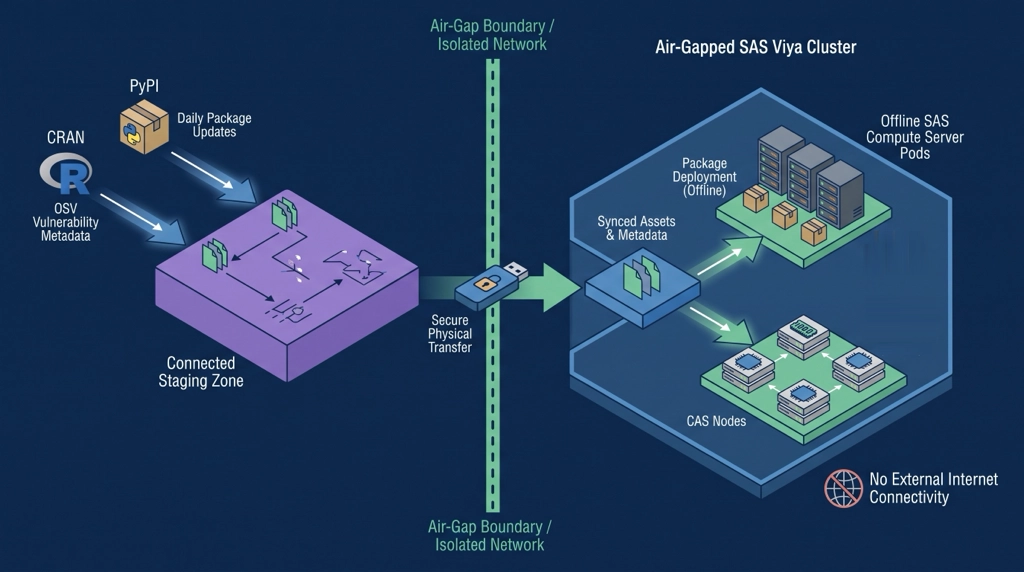
Achieving enterprise-grade open-source analytics requires a complete defence-in-depth architecture. SAS Viya and Posit Package Manager operate together to secure the entire analytical lifecycle—from the moment an open-source package is mirrored from PyPI or CRAN, through the sas-pyconfig build process, to the exact millisecond code executes inside a production batch pipeline or distributed CAS session.
For IT, Analytics, and Security leaders, the mandate is clear: securing the runtime environment is only half the requirement. Selerity invites technical leaders to audit their current open-source package supply chains. By deploying this dual-governance architecture, you empower your data science teams with the flexibility of open source while maintaining complete operational, security, and legal integrity.