


For many data leaders, the push to modernise analytics platforms often stirs hesitation. While the industry buzzes about the flexibility of open-source tools like Python and the power of cloud-native platforms, the reality on the ground when implementing SAS Viya & Python integration involves dealing with genuine concerns: data sovereignty, runaway cloud costs, and the governance risks of “shadow IT.”
It is the classic “if it isn’t broken, don’t fix it” mindset. However, in the current data landscape, standing still is often the riskiest move of all.
The good news? You do not have to choose between the stability of enterprise platforms and the flexibility of open source. SAS Viya Python Integration, can leverage the best of both worlds.
We often hear three main concerns from clients when discussing a move to cloud-native SAS Viya or Python integration:
These are valid concerns. However, treating them as blockers rather than challenges to be managed effectively prevents organisations from accessing the specific strengths that a hybrid approach offers.
To understand why SAS Viya and Python work so well together, it helps to rethink their roles.
Think of Python and its vast library ecosystem as a specialised set of high-quality power tools. It offers drills, saws, and routers that enable a master craftsperson to perform specific, intricate, and custom tasks with incredible precision.
However, a pile of power tools does not make a factory.
SAS Viya is the entire workshop. It provides safety standards, sturdy workbenches, climate control, inventory management, and insurance. It is a governable, secure environment where those power tools can be used safely and effectively at an industrial scale.
The biggest technical hurdle in a hybrid environment is usually data locality—moving data back and forth between engines is inefficient and costly.
The solution lies in the SWAT (SAS Scripting Wrapper for Analytics Transfer) package.
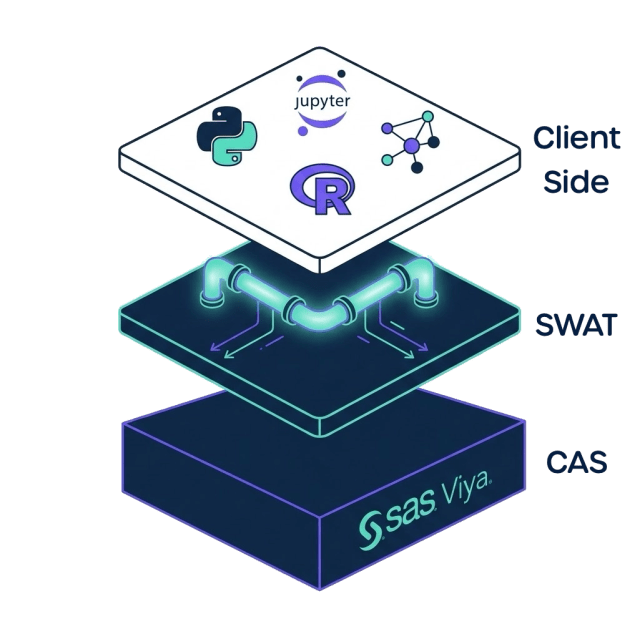
This package solves the locality issue by allowing Python to act as the scripting language, or “client,” while using SAS Cloud Analytic Services (CAS) as the high-performance compute engine. This means you can write code in Python, but the heavy lifting happens inside the robust, in-memory engine of SAS Viya.
For a deeper technical dive, SAS provides an excellent guide on getting started with SAS Viya 4 and Python here.
This is where Selerity steps in. We understand that while your Data Scientists want to code, and your Governance Risk & Compliance (GRC) team wants security, nobody wants to spend their days managing the plumbing of a hybrid architecture.
As Managed Service specialists, we handle the heavy lifting of the setup and maintenance:
For the Data Scientist hesitating to integrate their stack: don’t compromise.
Python scores high on developer flexibility; SAS Viya keeps the process and governance teams happy. Selerity handles the complexity of the infrastructure so you can focus on the analysis.
It is not about choosing one over the other. It is about building a better workshop.
Ready to renovate your data workshop? You shouldn’t have to worry about the plumbing.
Contact Selerity today for a discovery session, and let’s discuss how we can secure your open-source tools within a robust SAS environment.